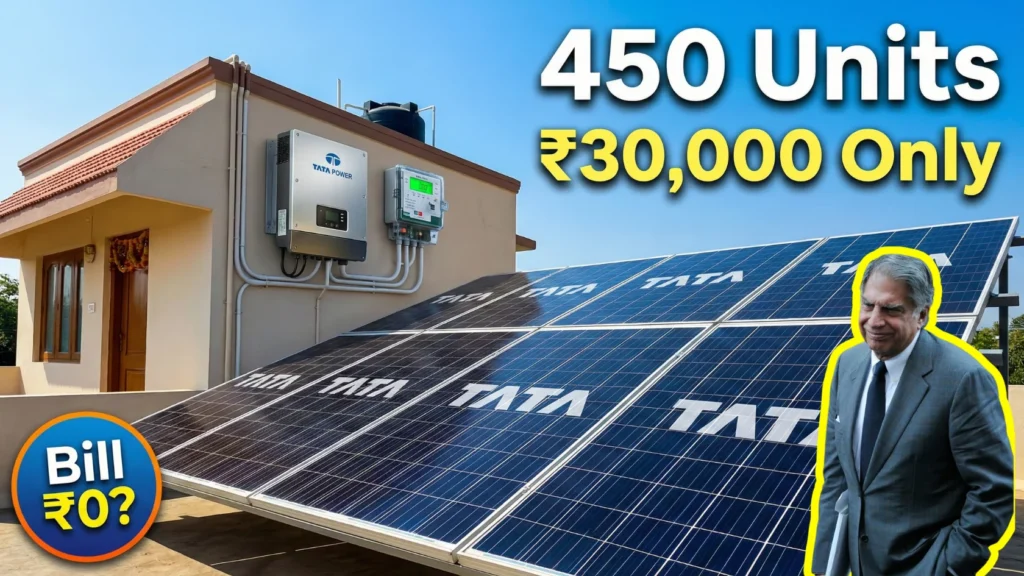
Tata Solar Panel: A “₹0 electricity bill” claim becomes real only when solar generation matches your billed units and net metering works properly. Tata solar panels can absolutely cut bills to near-zero for many middle-class homes, but the result depends on one clean equation: monthly consumption vs monthly solar units. If your home uses 300–450 units per month and your rooftop system generates 300–450 units, the bill can drop to a minimal fixed charge level instead of a big amount. The story spreads because families want fixed monthly relief, and rooftop solar is one of the few upgrades where savings show up directly on the bill.
System And Installation Quality
A near-zero bill needs correct sizing and correct installation. A 3kW rooftop system typically uses 6 panels of 540–550W or 7–8 panels of 375–450W, plus a 3kW grid-tied inverter, structure, DC/AC wiring, and protection devices. Roof space needed stays around 180–250 sq ft. Shade planning matters because even 1–2 hours shade from a water tank can cut output sharply. Earthing, surge protection, and proper conduit routing are non-negotiable because inverter failure stops savings instantly.
Generation And “₹0 Bill” Math
A 3kW system typically generates 10–15 units per day in many Indian cities, which equals 300–450 units per month. If your home billable usage is 300 units per month and solar generates 350 units, the extra 50 units can get adjusted through net metering based on DISCOM rules, pushing the payable amount close to the minimum fixed charge. If your usage is 500 units and solar generates 350 units, your bill drops but never becomes ₹0. This is why matching system size to your real monthly units is the only way to make the ₹0 headline feel true.
Net Metering And Usage Pattern
Net metering is the deal-maker. Homes that consume power in daytime directly use solar units and reduce bills instantly. Homes that stay empty in daytime rely more on export credits, so net metering approval becomes essential. Output drops with dust and flat mounting, so cleaning every 15–30 days protects savings. Inverter monitoring helps track daily generation and catch faults early, because even 7 days of zero generation can destroy the monthly savings number.
Warranty, Maintenance And Safety
Panel performance warranty terms are long, but the inverter warranty and service response decide real uptime. A grid-tied system has low maintenance because there is no battery replacement cost. Safety must include DC isolator, AC MCB, surge protection device, and proper earthing. During power cuts, grid-tied solar shuts down, so “bill ₹0” is separate from “backup comfort.” Backup needs a hybrid inverter and battery, which increases project cost.
Price, Subsidy And EMI Shock
A Tata 3kW rooftop solar setup is expected to cost ₹1.50 lakh–₹2.10 lakh depending on panel wattage, inverter grade, structure quality, and wiring, and subsidy under PM Surya Ghar structure can reduce the effective cost by up to ₹78,000 for eligible 3kW residential installations, bringing net cost closer to ₹72,000–₹1.32 lakh after approval and credit. EMI can start at ₹1,999 per month with a ₹25,000 down payment on a 60-month plan for a net-cost case near ₹1.20 lakh, while a higher net-cost case near ₹1.55 lakh can sit around ₹2,799 EMI with a ₹30,000 down payment on the same tenure. If your monthly use is 300–450 units and generation matches it with net metering active, the bill can drop near ₹0 apart from fixed charges, which is the real middle-class relief.