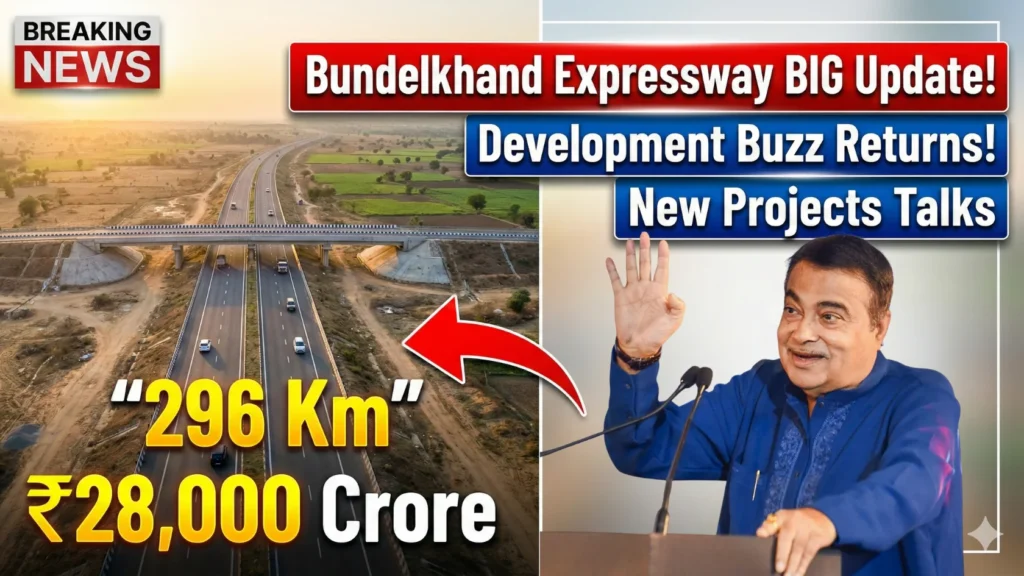
The 296Km Bundelkhand Expressway keeps pulling attention in poor and under-developed districts because big roads don’t just cut travel time—they pull new projects, jobs, and land demand toward places that were earlier ignored. The “₹28,000 crore development buzz” is trending again mainly because people are mixing multiple announcements: the expressway’s original construction cost, new spur-link plans, industrial corridor activity, and logistics/solar projects being discussed around the same belt. The real story is still powerful: Bundelkhand is now positioned as a connectivity corridor, and that naturally attracts industries, warehouses, tourism movement, and government-backed infrastructure planning.
Design and Build Quality
This expressway is an access-controlled, four-lane corridor (expandable to six lanes) developed by UPEIDA, connecting Chitrakoot to Etawah and linking into the Agra–Lucknow Expressway. It passes through seven districts: Chitrakoot, Banda, Mahoba, Hamirpur, Jalaun, Auraiya, and Etawah. For poor districts, this is important because it changes the “distance problem”—markets, hospitals, colleges, and business movement become faster and more predictable.
Also Read: TVS Jupiter Electric 2026 Launched..! 120Km Range, 4Hr Charging Time, Price ₹92,000
Connectivity and New Projects Pressure
Project pressure builds when feeder links start getting planned. A clear example is a proposed 15Km four-lane spur route to connect the Bundelkhand Expressway more directly to Chitrakoot, with a reported project cost of about ₹515 crore. This type of spur link matters because it improves last-mile connectivity for industrial zones and freight movement—exactly the thing that triggers new warehouses, transport hubs, and service businesses near junctions.
Industrial and Logistics Boom Signals
Bundelkhand’s development narrative is increasingly tied to industrial planning. Jhansi area nodes in the UP Defence Industrial Corridor have been highlighted as active investment choices, with talk of land allocation and multi-thousand-crore proposals. Separately, state-level planning discussions have mentioned pushing logistics park development and link connectivity to strengthen Bundelkhand’s industrial rise. This is the kind of ecosystem effect that can bring small factories, vendor units, worker housing, and service businesses into nearby poor districts.
Solar and Corridor Economy Angle
Another “big-project” layer is the solar belt idea. Reporting has said UP earmarked around 1,700 hectares along the Bundelkhand Expressway for solar energy plants, with the aim of building a solar-powered corridor concept. Whether every piece lands quickly or not, such planning often increases land interest near the expressway because it signals long-term government-backed activity.
₹28,000 Crore Buzz vs Real Numbers (And What Poor Families Should Do)
One key clarification: official press information around the expressway’s construction cost has been around ₹14,850 crore (approx). The “₹28,000 crore” number typically appears when people combine multiple projects (expressway + links + industrial parks + solar + local packages) into one headline. For poor families, the smart move is not panic buying land—it’s tracking interchange zones, official spur-route notifications, and industrial node announcements, because those are the places where demand usually builds first. Land prices can rise, but the safest gains usually happen where access roads are confirmed and paperwork is clean.