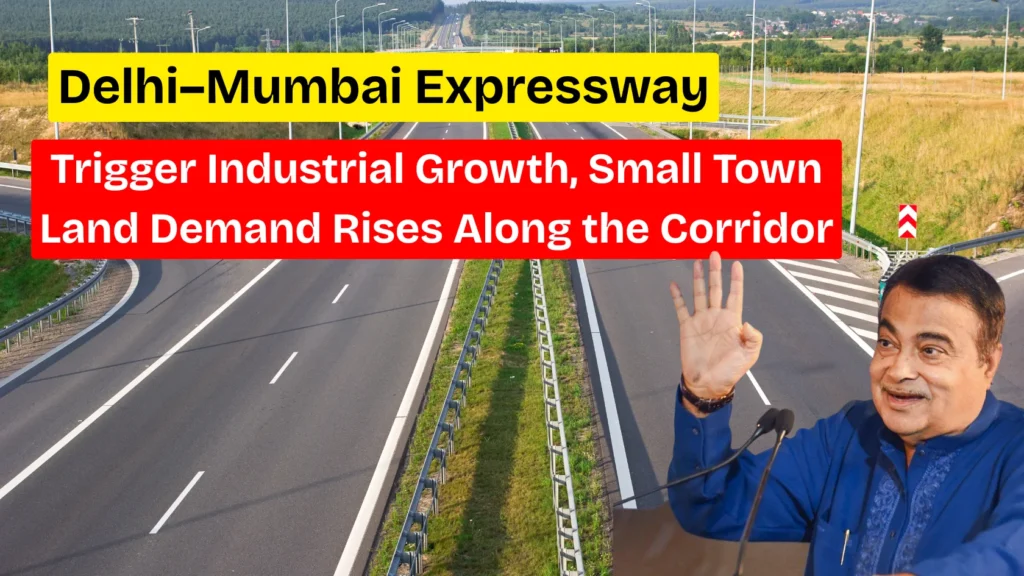
Delhi–Mumbai Expressway: India’s longest greenfield expressway is no longer just a road project; it is rapidly turning into an industrial and logistics backbone connecting North and West India. With a total length of about 1,386Km, this corridor passes through Delhi, Haryana, Rajasthan, Madhya Pradesh, Gujarat, and Maharashtra. The focus has now shifted from faster travel time to what is being built around the highway. Dedicated logistics zones, industrial parks, and warehousing clusters along the route are driving fresh investment and sharply increasing land demand in nearby small towns.
Expressway Project Scope and Connectivity
The expressway is designed for a 120Km/h speed limit and reduces travel time between Delhi and Mumbai from nearly 24 hours to around 12–13 hours. It directly connects major industrial regions such as NCR, Kota belt, Indore region, Vadodara zone, and the Mumbai–JNPT port network. Multiple access-controlled interchanges allow direct entry to nearby districts, making freight movement smoother and more predictable. This time reliability is critical for logistics operators and manufacturers.
Logistics Zones and Industrial Planning
Along the corridor, planned logistics parks and industrial nodes are being developed near key interchanges. These zones are meant for warehousing, cold storage, freight terminals, and light manufacturing units. Locations near Sohna, Jaipur outskirts, Kota, Ratlam, Mandsaur, Vadodara, and Vapi are seeing structured land aggregation for logistics use. Proximity to the expressway cuts fuel cost, transit delays, and inventory holding time, which directly improves business margins.
Impact on Manufacturing and MSMEs
The expressway enables factories to move raw material and finished goods faster between North and West India. MSMEs benefit the most, as they can now set up units in lower-cost towns instead of metro outskirts. Textile, auto components, FMCG warehousing, pharmaceuticals, and agri-processing units are early movers. Reliable road access also attracts export-oriented units that depend on ports in Gujarat and Maharashtra. This shift decentralises industrial growth away from crowded metros.
Rising Land Demand in Small Towns
Land prices in villages and small towns within 5–10Km of major interchanges have seen noticeable appreciation. Agricultural land is being converted into industrial and logistics-use plots where zoning permits. Demand is driven by developers, transport companies, and small manufacturers planning long-term facilities. In many stretches, land values have reportedly doubled from pre-project levels, especially where expressway sections are operational or nearing completion.
Employment and Local Economy Effects
Logistics parks and industrial units generate direct jobs in warehousing, transport, loading, packaging, and plant operations. Indirect employment rises through housing demand, retail activity, repair services, and local transport. For local populations, this means income opportunities without migrating to metros. Improved road connectivity also boosts access to markets, healthcare, and education, strengthening the regional economy.
Long-Term Strategic Importance
Beyond real estate gains, the expressway strengthens India’s supply chain resilience. Faster freight movement lowers logistics cost as a percentage of GDP, which is a national priority. The corridor supports industrial corridor planning, port connectivity, and export competitiveness. Over time, towns along the route are expected to evolve into logistics-led growth centres rather than remaining purely agricultural regions.
Disclaimer: The information provided in this article is for general informational purposes only. Project timelines, land use policies, industrial development plans, and price trends may vary by state, district, and local authority. Readers should verify details with official government notifications and local planning departments before making investment or business decisions.