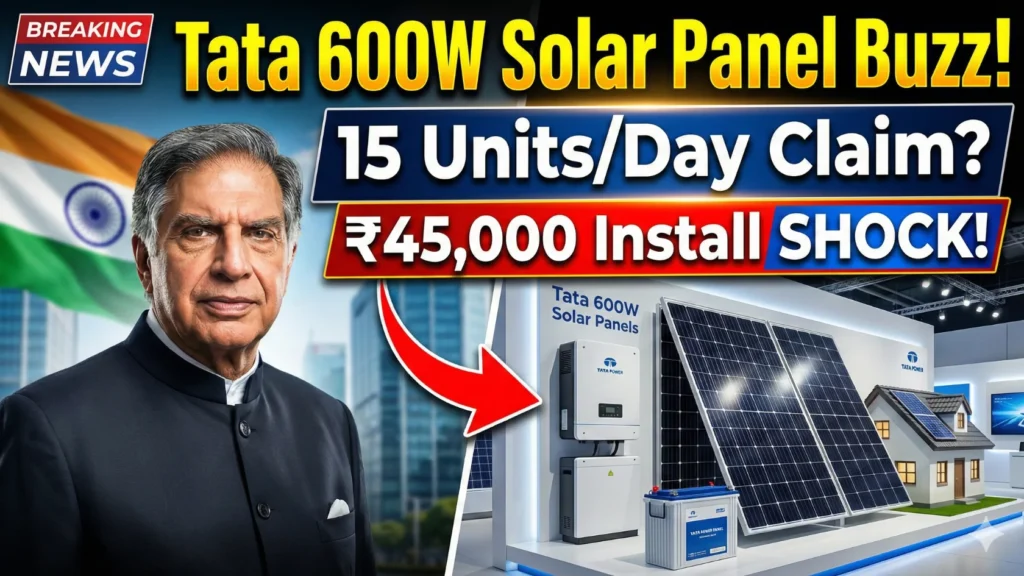
Tata solar panels are suddenly being discussed in poor and middle-class households because the headline sounds like a dream deal: a 600W panel, a 15 units/day claim, and an installation cost of just ₹45,000. For families who feel electricity bills every month, anything that promises near-zero bill pressure becomes instantly viral. But the smartest way to look at this is with real-life math: solar can absolutely reduce bills, yet daily unit generation depends on total system size, sunlight hours, and installation quality. If the plan is structured correctly, this kind of setup can still be a strong relief option even if the viral claim is exaggerated.
Design and Build Quality
In solar, the “build quality” is not only the panel—it is the complete installation. A strong mounting frame matters because wind and storms can damage loose panels and reduce output. Proper wiring, earthing, and safe inverter placement decide whether the system runs smoothly for years or becomes a repair headache. Households in the poor and middle-class bracket usually want one thing: a setup that works daily with minimal maintenance. That is why branded installs are expected to use durable structures, weather-resistant components, and clean cable routing that reduces safety risk.
Installation Cost and Daily Output Reality
A ₹45,000 install cost sounds possible for a small entry setup, but the 15 units/day claim needs careful interpretation. A single 600W panel typically produces around 2.4–3.0 units per day in many Indian conditions, assuming roughly 4–5 peak sun hours and normal losses. To reach 15 units/day, you usually need around a 3kW system (for example, five 600W panels = 3kW), not just one panel. That means ₹45,000 may be realistic for a small starter setup, but a true 15 units/day system usually costs more unless heavy subsidy support is applied.
Subsidy and Savings Logic
Subsidy is what can make solar feel “poor-family friendly” because it cuts the upfront burden. When subsidy is available, families can move from “I can’t afford solar” to “I can plan solar.” Savings depend on how much power you use daily and how much your system generates. A small setup helps with lights, fans, TV, and basic appliances, while a bigger setup can cover larger loads and reduce bills more aggressively. The key is matching system size to real household consumption, not just buying the smallest option and expecting maximum output.
Features and Safety Features
A safe solar setup should include proper earthing, MCB protection, surge protection, and a reliable inverter with overload safety. Net metering support can be a major advantage where available, because extra units exported to the grid can reduce effective billing. Monitoring features like a generation display or app are useful because families can quickly spot if output drops due to dust, shading, or a wiring issue. For poor households, this is important because early detection prevents bigger repair costs later.
Price, EMI, and Final Reality Check
If installation truly starts at ₹45,000, it can be attractive for poor and middle-class families, especially if an EMI plan comes near ₹1,299–₹1,999 per month. Many households can mentally replace part of their electricity bill with an EMI, and after payoff, the savings become long-term. But one thing should stay clear: 15 units/day output typically needs around a 3kW system, not a single 600W panel. The best approach is to confirm the exact system size included in ₹45,000, and then choose the capacity that realistically matches your home’s daily units.