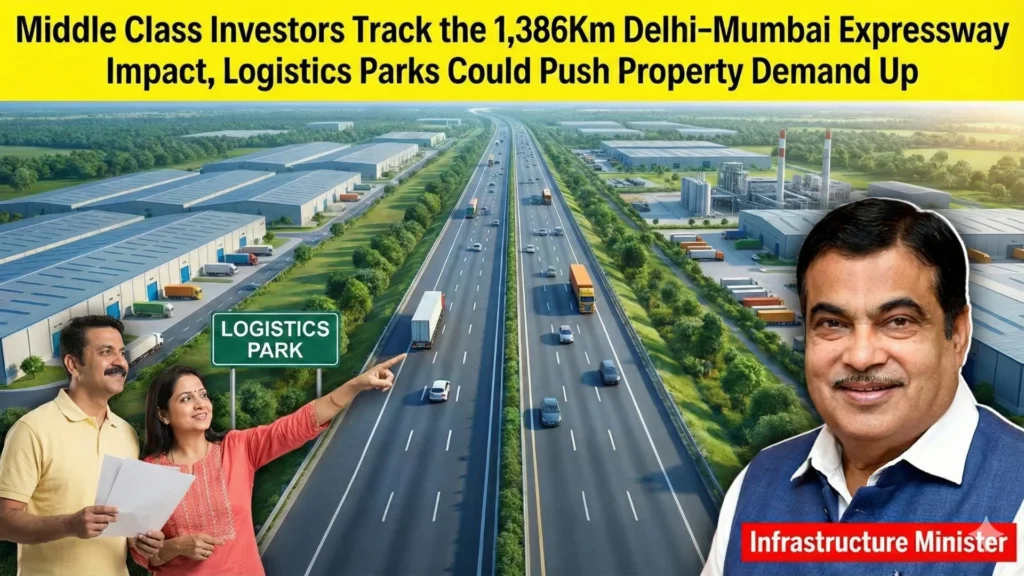
The 1,386Km Delhi–Mumbai Expressway is increasingly on middle-class investors’ radar because it’s not just a travel project—it’s a land-and-business corridor story. As more sections get operational and remaining stretches move toward completion, the “next wave” typically comes from logistics parks, warehousing, and industrial spillover, which can pull workers, rentals, and commercial demand into new pockets. Recent updates also show parts are still progressing (including a Delhi-side stretch expected to be operational by June 2026), which keeps investors tracking timelines closely.
Design and Build Quality
This expressway is planned as an access-controlled, high-speed corridor connecting multiple states (Delhi, Haryana, Rajasthan, Madhya Pradesh, Gujarat, Maharashtra). The key investor point isn’t only the road surface—it’s the interchanges, feeder links, and service ecosystems that form around it. Wherever there’s a clean interchange, developers and operators start visualizing truck parking, fuel stations, food stops, and warehousing clusters.
Route Connectivity and Time-Saving Effect
The expressway’s biggest promise is that it can cut Delhi–Mumbai travel time to roughly 12–14 hours compared to older routes, which directly changes logistics planning and freight movement patterns. When travel time becomes predictable, companies shift routes, and that’s when new land demand begins near exits and junctions—especially for storage, last-mile distribution, and service businesses.
Logistics Parks and the Property Demand Link
The “logistics parks” angle gets stronger because the expressway sits in the wider influence band of the Delhi–Mumbai Industrial Corridor, where a broad region is planned for industrial and infrastructure development. In practical terms, industrial corridors + fast roads often mean more demand for warehouses, worker housing, rental rooms, small retail, and roadside commercial plots near access points. This is why investors track not just the expressway but also node development and industrial activity around the corridor.
Features and Risk-Check for Investors
The opportunity zones are usually 0–3Km from interchanges and along strong feeder roads, but the risk zones are also real: unclear access roads, land-use restrictions, disputed titles, and “dealer hype” without official connectivity. Another risk check is timeline slippage—there have been cases where delays led to contract actions, which reminds investors that completion is not always perfectly smooth. Smart investors track official construction progress and avoid buying purely on viral claims.
Price Movement Logic and Smart Strategy
Typically, land and property moves in stages: buzz → survey/marking → visible construction → operational traffic. The sharpest price movement often comes after traffic becomes routine and businesses start operating, not when the first headline drops. A safer strategy for middle-class investors is to focus on legal clarity, approach-road certainty, and interchange proximity, and to think in “lease potential” (warehousing, small shops, rentals) rather than only resale. That’s where logistics-led demand can create more stable, long-term returns than pure speculation.